
A patron saint is a holy person in Christian tradition who is believed to look after a specific group of people, place, or need. They act like a spiritual guardian or helper, praying for those connected to them. People turn to their patron saint for guidance, protection, and inspiration because the saint’s own life reflects something about the need or situation.
Here are a few simple, easy-to-understand reasons why we have patron saints:
St. Patrick was a powerful model of a missionary who trusted completely in God, a former slave who returned to his captors with a message of love, and the man responsible for planting the deep roots of the Catholic faith in Ireland, which would in turn spread throughout the world. His life is a testament to the belief that God can use anyone, no matter how humble or unlikely, to do extraordinary things.
St. Patrick is the foremost patron saint of Ireland and a towering figure of missionary evangelization, whose life exemplifies faith, perseverance, and the power of God’s grace. His importance goes far beyond the secular celebrations of his feast day. Here is a breakdown of who he is to Catholics:
This is his primary title. He is credited with single-handedly converting the pagan Irish island to Christianity in the fifth century. Before Patrick, Christianity was barely present in Ireland. Through his decades of missionary work, he established the Irish Church, ordained priests, and founded monasteries that would become legendary centres of learning and faith for centuries.
We know St. Patrick’s story from his own writings, primarily his Confessio (Confession). Key elements of his life that resonate deeply with the faithful are:
Patrick’s method of evangelization is a model for the Catholic Church. He did not conquer by the sword but by persuasion and inculturation. He is famous for:
Two prayers are intimately connected to him, demonstrating his deep, trusting faith:
Like many saints, tradition attributes many miracles to St. Patrick, which for Catholics confirm his holiness and God’s favour upon his mission. The most famous legend is that he banished all snakes from Ireland, which is symbolically understood as driving out pagan evil and idolatry from the island.
1. A Witness to Healing
Patrick’s early life was marked by trauma and loss. Yet God transformed his suffering into a source of compassion. Our chapel seeks to mirror that same healing presence for those wounded by life or church.
2. A Mission of Hospitality
Patrick returned to the very people who once harmed him—not with judgment, but with love. This radical hospitality inspires our ministry to welcome all without condition.
3. A Contemplative Spirit
Before Patrick became a missionary, he was a man of deep, solitary prayer. The stillness and simplicity of Celtic monasticism echo strongly in our Benedictine contemplative life.
4. A Faith Rooted in Everyday Life
Patrick taught that God is close—in the wind, the light, the work of hands, and the journey of a day. Our chapel embraces this intimate, incarnational spirituality, trauma, and loss. Yet God transformed his suffering into a source of compassion. Our chapel seeks to mirror that same healing presence for those wounded by life or church.
A Prayer: Christ Be In All Who Love Him
May the courage of St. Patrick strengthen us.
The prayers of St. Patrick surround us.
And the light of Christ—which burned so fiercely in his heart—
Guide our chapel and each person who enters it.
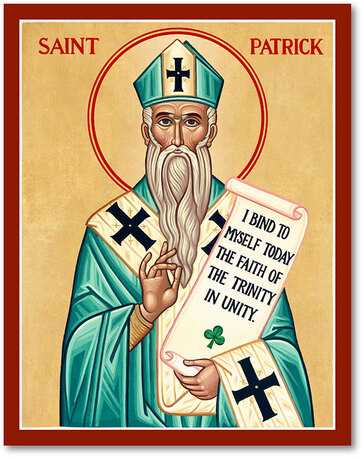
Icon of St. Patrick